
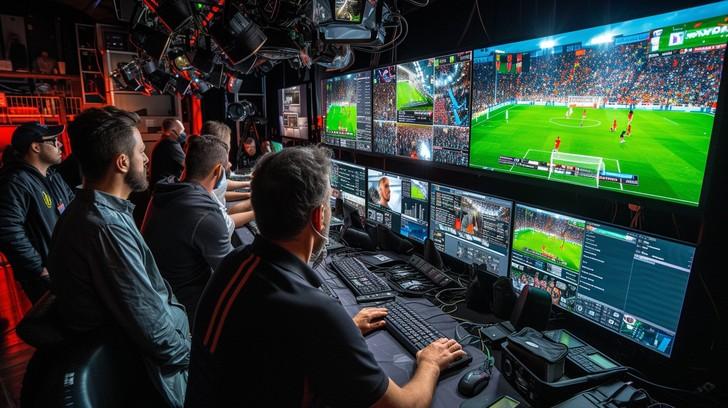
The Sports Broadcasting Technology Market Opportunities in the Sports Broadcasting Technology Market are expanding fastest where fan expectations exceed the limits of traditional linear broadcasts. Viewers increasingly want interactive features—alternate camera angles, selectable audio, synchronized stats, real-time polls, and co-viewing experiences—delivered with minimal latency on mobile and connected TV. This drives opportunity for innovators building low-latency streaming stacks, metadata-rich workflows, and presentation layers that can personalize experiences without fragmenting operations. Rights holders also want faster content repackaging: instant highlights for social media, condensed games for on-demand viewing, and team- or player-focused compilations.
That creates opportunity for AI-assisted systems that detect key moments, generate clips, and attach accurate metadata for search and recommendation. Another opportunity lies in production cost transformation. Leagues that previously could not afford full broadcast coverage for every match can now scale coverage via remote production, cloud replay, and templated graphics packages. Vendors that make “broadcast-grade but lightweight” workflows accessible—without sacrificing reliability—can unlock new event inventories and revenue streams. Finally, the commercialization stack is changing: dynamic sponsorship overlays, targeted ads, and region-specific variants require tight integration between production, rights policies, and ad decisioning. Technology providers that connect these pieces into a measurable workflow can benefit from expanding budgets tied directly to monetization.
Personalization and multi-output production are particularly fertile opportunity areas. Many organizations now need a single event to yield a traditional world feed, localized language feeds, a vertical mobile stream, and multiple social-first cuts. Building these variants manually is expensive and error-prone, so there is strong demand for automation: rules-based clipping, template-driven graphics, and cloud rendering that can output multiple aspect ratios and bitrate ladders. This also opens opportunities in metadata standardization. When every event, player, and moment is tagged consistently, downstream products—interactive overlays, search, recommendations, and highlight licensing—become easier to monetize. AI can help generate these tags, but the biggest opportunity is operationalizing AI reliably: confidence thresholds, human review queues, and audit trails that make automation safe during live games. Audio is another underexploited opportunity. Personalized mixes (commentary-forward, crowd-forward, home/away radio) can increase engagement, but require flexible routing, object-based mixing, and robust device support. As fans adopt immersive audio and higher dynamic range video, opportunities also rise for workflow upgrades that preserve quality from venue capture through encoding and playback, including monitoring that detects quality regressions before viewers complain.
Sports betting and real-time data integrations create a high-growth opportunity, but they demand precision. In-play betting requires trusted event timing, synchronized data feeds, and latency control so that odds and prompts align with what viewers see. This supports demand for time-stamped data pipelines, integrity monitoring, and “latency-aware” distribution that can deliver consistent delays across regions. AR and virtual graphics also benefit from real-time tracking data and calibrated cameras; vendors that simplify calibration and automate overlay alignment can scale AR beyond flagship matches.
Another opportunity is remote and distributed production maturity: better comms, synchronized multiview, remote shading, and robust control surfaces can make remote workflows feel indistinguishable from on-site trucks. Sustainability adds a further angle—remote production reduces travel, and efficient cloud orchestration reduces idle compute—so vendors that quantify carbon and cost savings can strengthen business cases. Additionally, anti-piracy capabilities are becoming revenue-protecting necessities; watermarking, fingerprinting, and takedown automation are attractive because they directly defend rights value and subscription revenue.
Commercial models are evolving, creating opportunity for vendors that align pricing with sports calendars. Many rights holders prefer subscription or consumption models that scale for playoffs and shrink in the off-season, provided costs are predictable and governed. This favors platforms offering per-event packaging, pre-defined service tiers, and built-in cost controls for compute and egress. Managed services represent another major opportunity: leagues building DTC offerings often want 24/7 monitoring, incident response, and continuous optimization without staffing a full broadcast engineering team.
Top Trending Reports:

 English
 Arabic
 French
 Spanish
 Portuguese
 Deutsch
 Turkish
 Dutch
Dutch
 Italiano
 Russian
 Romaian
 Portuguese (Brazil)